


EFAMA has released a joint statement together with AFME (Association for Financial Markets in Europe), EFSA and the Nordic Securities Association on significant issues with the supervision of market data costs.






EFAMA has released a joint statement together with AFME (Association for Financial Markets in Europe), EFSA and the Nordic Securities Association on significant issues with the supervision of market data costs.


Clarification is urgently needed to enable rather than restrict EU sustainable investment
The EU has been at the forefront of green bond issuances, demonstrating strong growth and commitment to sustainable finance. However, ESMA’s new Fund Naming Guidelines create inconsistencies with other sustainable finance regulations, like the EU Green Bond Standard, which could hamper the growth of the corporate green bond sector.

The Associations fully support ESMA’s aim of providing for an adequate level of transparency. This will be beneficial to investors, liquidity providers, other intermediaries, as well as issuers, across the entire range of different and diverse bond classes.

EFAMA publishes its latest Monthly Statistical Release for July 2024.

Regulatory clarity required to sustain further growth

This report looks specifically at the evolving trends of the equity asset class of sustainable UCITS, whose share is the highest (53%) in total sustainable UCITS funds. It highlights their role as investment vehicles in facilitating the green transition. The universe of sustainable equity UCITS funds is defined based on Morningstar’s classification of sustainable financial instruments1. This means funds must claim to have a sustainability objective, and/or use binding ESG criteria for their investment selection.



We commend the work that IOSCO has undertaken to date on this topic including the survey work and the summary findings in the form of the report currently under review. It is fair to say that the conclusions of the report and areas for further work gave rise to detailed discussions within our industry, yielding ultimately firm views on the priority areas that we support and see value in, and areas we felt were not reflected in the study and thereby building risk into margining models in future crisis scenarios. These areas are fur

For asset managers the main issue continues to be the reclassification of ETDs as OTCs as a result of the non-equivalence of UK regulated markets. While we understand that a review is legally mandated at this point in time, we do not see value in recalibrating the various thresholds or making changes to the calculation methodologies unless these are in the two areas we define below. Our main concern revolves around the fact that changes would carry significant compliance costs while making little impact on the population of counterparties and notional captured by the thresholds.
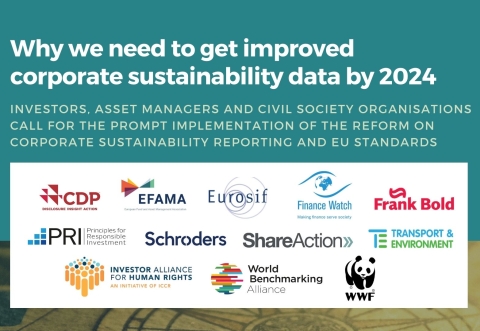
Investors, asset managers and civil society organisations call for the prompt implementation of the reform on corporate sustainability reporting and EU standards


This is a timely and necessary review to which we hope to contribute in a constructive manner. As already recognised in the consultation paper and in the MiFID Quick Fix proposal, RTS 27 and RTS 28 currently fall short of the objective of providing valuable and comparable datasets for investment managers and the investing public. We appreciate the present effort to revise reporting requirements to produce more meaningful reports.

The Joint Associations1 welcome clarification from ESMA that national competent authorities are expected not to prioritise supervisory actions in relation to the application of the CSDR buy-in regime.2
Discover the 6 reasons why your organisation should become a member of EFAMA.
Our members enjoy significant benefits including the opportunity to shape the industry positions, get first-hand access to regulatory and political intelligence, engage with industry peers and policymakers, and take part in EFAMA events.
Our three membership categories cater to the wide range of organisations that make up and support the investment management industry in Europe.